
Why are we so fucking lonely?
Loneliness has been such a common topic of conversation over the last few years. And if you spend anytime on the internet these days, you’ve likely heard people say things like “everyone wants a village, but no one wants to be a villager.” Across the board, it seems like people are having a tough time making and keeping connections with friends, as well as feeling valued in the friendships they do have.
In my own life, I have noticed that people’s habits of hosting and going out has really changed. So that got me thinking…. how bad is it actually? And what is the cause of it?
Who’s lonely?
The American Psychological Association (APA) conducted a survey on stress levels recently, and found that 6 in 10 adults in the U.S. are experiencing loneliness. Of those, over half said they felt isolated, left out or lacked companionship often or some of the time.
Looking at the who specifically, Pew Research found that adults aged 18-29 reported feeling lonely or isolated all or most of the time (24%), with 30-49 year olds close behind (20%). By gender, men and women were extremely close, with men at 16% and women at 15%. However, women appear to be far more likely to look for support with their emotional wellbeing than men.
An interesting piece of Pew’s survey includes how people are communicating with each other. Text messages and social media are the predominant forms of communication with people across both genders. But a common concern people raise with these forms of communication are that they are impersonal, with some people communicating only through shared posts in DMs and minimal heartfelt conversations or real updates.
Why are they lonely?
Based on the conversations you hear online, it seems like common themes for why we’re feeling so lonely tend to include things like more social media time, capitalism, rise in fascism and individualism, and remnants of COVID. And according to a study conducted by Harvard’s Making Caring Common Project, those seem pretty spot on. Technology was cited by 73% of those surveyed as a major contributor, while being overworked and people becoming more individualistic landing at around 60% each.
Around 60% of people surveyed also mentioned they felt like they weren’t able to share their authentic selves with others. I’ve definitely heard this from people, especially younger generations, who felt like they would be judged for being “cringe.” As a millennial, when I would first hear that, I would sort of shake my head and think “just do what you want!”
But after spending more time with people who felt this way, it was clear that it’s not quite that simple. When you have people chronically online, ready and willing to share videos or photos of people they took without permission, it’s easy to be worried about what is being said or shared about you. It can really make you feel like you have to be putting on a performance at all times, which is incredibly exhausting.
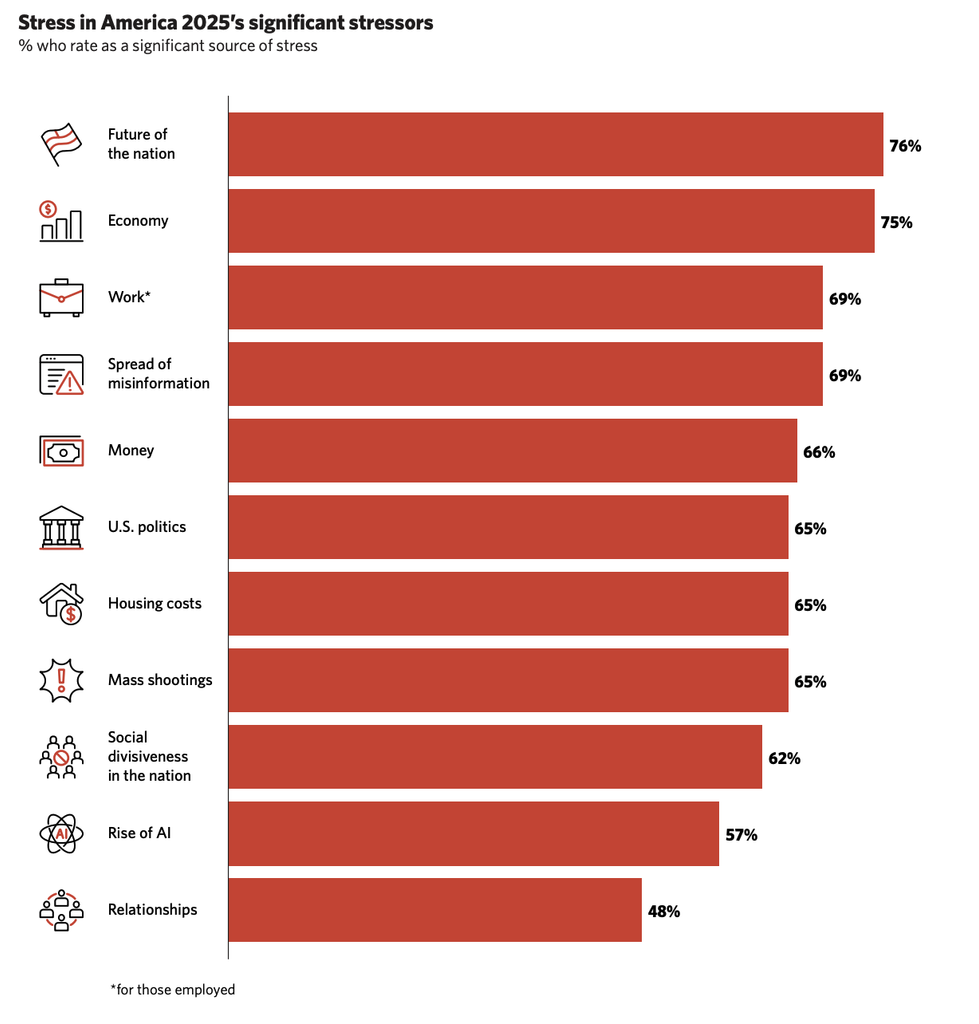
Diving further into loneliness, stress is a major contributor to it as when we’re highly stressed, it can lead us to disconnect to those around us. The APA’s survey highlights some of the key stressors people face as:
What do we do about it?
Building connection with people is more important than ever as stressors and feeling of isolation continue to rise. There is obviously no one size fits all approach to fixing this, and sometimes the recommendations people give can feel a little tired.
Identify Your Stressors:
There will always be stressors in our lives, but how we handle it can make a huge impact on our lives. I know that the world feels like a complete garbage fire right now, but there ARE ways to combat it. For example, I am pretty plugged into the news and what’s happening in the world. I firmly feel that while I can simply turn off the TV or stop looking at my phone, others are living the news I’m watching in their daily lives and they can’t just step away from it like I can. Therefore, I have a duty to pay attention and understand what is happening.
Obviously, that’s emotionally draining and overwhelming at times. But because I feel it’s important to not stop, I’ve try to be as constructive with how I consume information and what I do about it. For example, when I find out a topic that regularly comes up, I try to find resources to learn more about it and become more educated on the situation. That helps me feel more in control about what I’m consuming and how I react to it.
I also work with a therapist and that really helps ground me and gut check how I’m doing emotionally and mentally, and gives me tools and exercise to handle stress. While therapy is one option, there are countless other ones as well. The National Alliance on Mental Illness (NAMI) and Healthline gives a several strategies that people can follow. The best thing you can do is find out what works for you and your needs.
Planning Things Yourself:
Often times, people recommend things like being more willing to reach out and plan. But I think it’s important to understand how much of a toll that can take on a person. As someone who loves to plan events and give people an excuse to meet up, it does annoy me how I’m often the only person who will plan things in a group. But what I noticed is that the people who do show up, always have a good time and comment on how they appreciate me taking the time to plan things.
For party planning, I try make it as easy for myself as possible to plan things. I use a platform called Partiful, which makes it a quick click to invite people and I send out a copy/paste message out to people when needed (sometimes tailored to the individual). I also know that there is a good chance that a number of people who RSVP may drop out last minute (typically 2 hours before the event when Partiful sends the reminder texts) and I try not to let it get to me. HOWEVER, if someone cancels last minute every single time, then I’m willing to just not invite them for future events. Building connection with people is a two-way street.
Meet Ups/Special Interest Groups:
Other suggestions people make are attending groups tailored for people looking to make connection with others. Sometimes that’s a book club or a meet up about a specific topic. If you attend one, I think it’s important to really put yourself out there and be willing to feel uncomfortable talking to strangers. You also have to be willing to walk out of the door at the end of the night not having made a strong connection with someone. There are so many people out there in the world, and you’re not always going to mesh with every single one of them.
One thing I’m opposed to, though, is having to pay a premium for meet ups. I think that it’s silly (especially in this economy) to expect people to pay money for the chance to meet a friend. If you feel the same, please set your expectations accordingly though. Because obviously, if you’re attending a free event, that has a different experience than one with a budget.
If you go to a group, put your best foot forward and have things to discuss. Bring questions. Know how you want to “pitch” yourself to people. Be willing to strike up conversations with new people and be OK with moving on if you don’t fit well with each other.
Showing Up:
From my personal experience, I’ve noticed a big uptick in the amount of people who cancel last minute or aren’t willing to do things that are considered inconvenient. For example, when a friend of mine was doing a bike race, it happened to be raining. Even though I could have easily said that I was staying in because of the rain (and general laziness), I put my raincoat on and got my ass outside. But when talking to people about other races they’ve been a part of, they mentioned that friends of theirs didn’t show up because they “just didn’t feel like it” or because of bad weather. I don’t think people hold it against others in this case, but it does mean so much when people show up for you. Just think about how you would feel if none of your friends came out to cheer you on.
Sometimes the best thing we can do for ourselves is push ourselves to get out the door and attend whatever it is that we are scheduled to do. When I chat about this with other people, they mention that once they get to the event, they feel fine, but finding the energy to leave your house in the first place can be difficult. The best thing you can do is find out what helps motivate you and follow through on your plans. It’s OK to arrive late/leave early (usually — please read the room), but showing up is important.
Take a Break from the Internet:
It is so easy to spend hours and hours on social media…. I am so guilty of this. But a potential way to build connection with people and ease stress is to take quality time away from the social media and the internet in general. While the internet is an awesome tool, it can also be the source of doom scrolling and misinformation. Finding ways to disconnect and be more in the moment can help you feel at peace with yourself and also find other people who are interested in spending time with you IRL.
I have been making a big effort to do this lately and I can really feel a change in how I feel in my day-to-day life. Some of the activities I do are just for me, like going for runs or walks with my dog. But I love getting a chance to go birding with a group or shooting a text to someone to walk through the local botanical garden/park. Plus, there are plenty of groups that are out in nature (e.g., hiking groups, run clubs, park walkers, birders) and are low-stress ways to build real-life connections.